|
Batteries There are three important decisions to make when you take the plunge to fly electric. Airframe. Will be based on how you want to fly and personal preference. Motor. Must be appropriate for the airframe you choose to maintain the flight envelope you enjoy. Battery Pack. Will determine motor performance and flight durations. There
are three factors that must be considered when choosing a battery. The
type of airframe you choose and your style of flying will play a part
in your decision. |
| A
second consideration will be how long you wish to fly. The mah (milliamperes
per hour)rating of a pack will be almost directly proportional to the
length of time you wish to fly. If you have a 600mah pack in airframe
X and can fly for 6 minutes, switching to a 1200mah pack of the same voltage
should give you about 12 minutes. This is close enough for our discussion
but technically the added weight of a larger pack will shave a little
off your flight time.
The third factor is cost. As weight goes down in battery technology, price goes up. And of course as amp hour ratings go up, so goes cost (and weight). Lets compare the three major battery types popular in todays E-planes. The most popular are Ni-Cads (Nickel Cadmium). Availability, ease of charge and maintenance, ruggedness and low price are a few reasons for their popularity. But (there is always a but) Ni-Cads are the heaviest. Next, and gaining popularity very fast are NiMH (Nickel Metal Hydride). They are a little pricier than there Ni-Cad counterparts, but are somewhat lighter per mah. So, for a given weight, you can get longer flight durations. Most chargers designed for Ni-Cads can also handle NiMH. The
third technology is Lithium-Polymer referred to here as LiPo's. First
and foremost LiPos's can be dangerous. More so that the two aformentioned
types. If overcharged or shorted a single LiPo cell can explode and
or catch fire. Note.
By definition a battery is a group of cells. A single Ni-Cad or Ni-MH
cell will generate 1.2 volts (force). Hence, when you hear reference
to a 7 cell pack just multiply 1.2 x 7 to get the pack voltage. A single LiPo cell will generate 3.7 volts. Packs will typically be 7.4v (2 cells) or 11.1v (3 cells) |
Here are some comparisons.
 |
 |
|
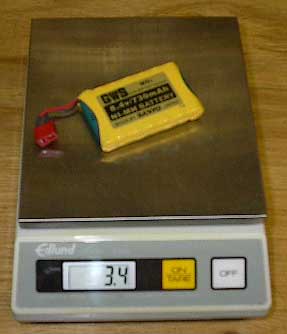
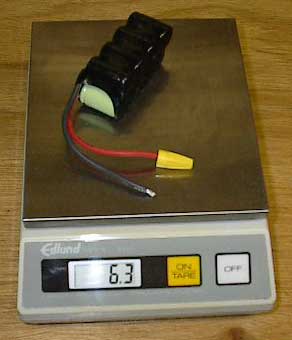
| 7 cell 8.4v 730mah NiMH. weighs in at 3.4 oz. and cost around $30. | 8 cell, 9.6v, 950mah NiMH weighs 6.3oz. and cost ~$20.00 | |
 |
 |
|
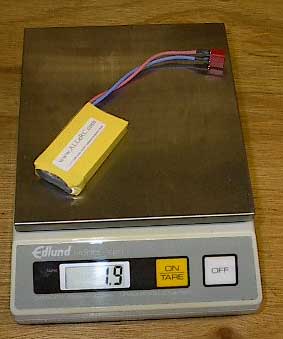
| 2 cell 7.4v, 1200mah Lipo. 1.9 oz and cost $35.00 |
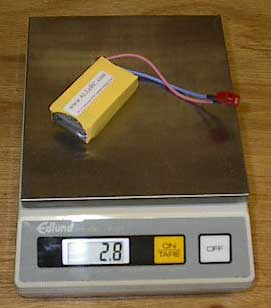
3 cell11.1 v, 1200mah Lipo. 2.8oz and cost |
As you can see, LiPo's
offer a lot of go juice at the least weight. They cost significantly more
than other types and require a special charger. More on chargers on the charger
page.
NiCad is a reliable, safe, affordable technology and will be with us a long
time.
Did I mention LiPo's can be dangerous?
